

How to Choose a Men's Daily Formula
This guide is a checklist, not a ranking. It walks through the decisions that actually change your routine and your cost per day: format, serving count, label clarity, and how to read a supplement facts panel without a nutrition background.

What this page does for you
A shortlist takes eight checks, and none of them are about hype
Work through the rows below once, in any order, and every product page on this site becomes faster to read. Each row names a decision, not a result.
Pick a format you will still be taking in month three
The formula that wins is the one that survives a busy Tuesday. A product you skip twice a week is not cheaper than a better one you finish, and switching formats in February means starting the habit from zero.
Tablets and caplets are compact, easy to store, and usually the lowest cost per serving among men's vitamin formulas. Capsules suit whole-food style products. Gummies are simple to remember but often carry shorter ingredient lists. Packs organise a month of separate items for you — more structure, more things to swallow before breakfast. Pick the format first, then compare only within that format.

Find the serving count before you look at the price
The serving count decides your real cost, and it is the line people skip. Divide the total count by the serving size printed on the label and you get the number of days the bottle covers.
A bottle of 120 caplets with a two-caplet serving is a 60-day supply. The same 120 caplets at one per day stretches to four months. Two bottles can share a shelf price and still differ by weeks of coverage, so run the arithmetic once per candidate and the comparison stops being guesswork.
Tablet and caplet line
Compact daily formats
2
caplets per serving
Whole-food capsule line
Capsules, food-forward
3
capsules per serving
Monthly pack program
Several items a day
30
days organised
Serving figures above follow the format label conventions used across the lines we review. Your own bottle's printed serving size is the number that counts — the arithmetic is the point, not our row.
What a transparent label shows you, and what a blend hides
Two labeling patterns run through the natural supplements for men market. The frame below sets them side by side, because one side gives you nothing to compare with.
Column
Transparent panel
Proprietary blend
Each nutrient listed
Named vitamin or mineral with its own amount
One total for the whole group
Percent daily value
Shown per nutrient, so you can read the row you care about
Usually absent per ingredient
Can you compare tiers?
Yes — against another numbered panel
No — there is no row to match
A blend is not automatically a problem, but it is a dead end for comparison. If you cannot see individual amounts and percent daily values, treat the row as unreadable and move on. Our ingredient glossary defines the terms you will meet on a panel.
Read the supplement facts panel before the marketing line
Open any product page and find the panel image. Start with the serving size line — one tablet or several — then scan the amounts for the nutrients you actually care about and note the percent daily values beside them.
Ignore the words at the top of the page until you have done this. They rarely change between tiers. If a listing hides the panel, shows only a corner of it, or replaces it with a photo of the front label, that is useful information too — you are being asked to buy on trust instead of numbers.
Readers looking at vitamins and minerals for men will meet the same layout on nearly every bottle: serving size, then a scroll of named nutrients, then a footnote about percent daily values being based on a general adult intake. Knowing the shape of that panel in advance is what makes it fast to read.
A workable reading order
Serving size line
Tells you whether a day is one object or several.
Named nutrients
Look for the rows you already decided you want, not all of them.
Percent daily values
A quick sense of how the row sits against a general adult reference.
Missing or partial panel
Note it and move on. A hidden panel ends the comparison.
This order works whether you are comparing two everyday lines or twenty search results.
Match the formula to the decade you are actually in
General adult formulas cover most readers in their twenties and thirties. Age-positioned products are built for a different audience, not a stronger one — the brand picked who the product is for, and that choice shows up in the nutrient mix and the daily serving.
If you are over fifty, read the age-positioned entries first and hold them against the general tier. If you are younger and active, a core daily formula or a sport-positioned line is the more direct comparison. Neither category is a promotion or a demotion; they are two labels aimed at different routines.

Crop the panel, not the promise. The layout is the same on almost every bottle.
Two decisions left: how much structure, and how much a month costs
Set both before you shop. The four cells below hold the routes most readers take, in the order we suggest reading them.
One bottle, one serving a day. The simplest daily routine and the easiest to keep.
A routine you already skip. Adding products to it tends to bury the new one too.
An organised month supply with several items per day. Good if you already take more than one thing.
Everyday supermarket and pharmacy tier. Sets the low end and is the honest benchmark for the rest.
Budget tablets such as Nature Made Multi For Him, which Good Housekeeping named best value in 2026, set the low end of the mainstream market and are commonly compared with Centrum and similar lines. Advanced formulas, including Nature Made Advanced Multivitamin Men, sit above that tier. Natural and whole-food options usually cost more per serving. Decide your daily number before you shop, then test your shortlist against it — a supplement you can afford every month beats a better one you buy once and stop.
Questions that come up while comparing bottles
+
How many days does a bottle actually last?
Divide the total count by the serving size. A 120-caplet bottle with a two-caplet serving lasts 60 days. Run this before comparing prices, because two bottles with the same count can differ by weeks of supply depending on the serving size printed on the label.
How many days does a bottle actually last?
Divide the total count by the serving size. A 120-caplet bottle with a two-caplet serving lasts 60 days. Run this before comparing prices, because two bottles with the same count can differ by weeks of supply depending on the serving size printed on the label.
+
What if the label lists a blend without amounts?
You cannot compare it against a numbered panel, so treat that as a limitation rather than a selling point. Prefer products that list each vitamin and mineral with an amount and a percent daily value. If a listing shows no panel at all, ask the seller or check the brand's own product page before ordering.
What if the label lists a blend without amounts?
You cannot compare it against a numbered panel, so treat that as a limitation rather than a selling point. Prefer products that list each vitamin and mineral with an amount and a percent daily value. If a listing shows no panel at all, ask the seller or check the brand's own product page before ordering.
+
Should I start with a pack or a single bottle?
Start with a single bottle unless you already take several products daily. Packs such as the GNC Mega Men Whole Body Vitapak Program suit readers who want structure and do not mind multiple items per day. Simplicity wins for most first routines.
Should I start with a pack or a single bottle?
Start with a single bottle unless you already take several products daily. Packs such as the GNC Mega Men Whole Body Vitapak Program suit readers who want structure and do not mind multiple items per day. Simplicity wins for most first routines.
+
How do I verify a listing that ships to Indonesia?
Confirm four things before paying: the exact product name, the format, the count, and the expiry date. If a listing shows a different count than the brand's own page, trust the brand page. Then store the bottle closed and dry, away from heat and direct sun — this matters more in a humid climate than most buyers expect.
How do I verify a listing that ships to Indonesia?
Confirm four things before paying: the exact product name, the format, the count, and the expiry date. If a listing shows a different count than the brand's own page, trust the brand page. Then store the bottle closed and dry, away from heat and direct sun — this matters more in a humid climate than most buyers expect.
Everything on this page helps you compare products. It is not a substitute for personal advice, and questions about your own needs belong with a qualified professional.
Beyond the mainstream tier
Where natural capsules for strength and vitality routines fit
Whole-food and food-forward lines take a different route: shorter panels, plant-based nutrient forms, and a capsule you take two or three times a day. The label is often clearer than the mainstream average, and the price per serving is almost always higher. Neither pattern is automatically better than a compact tablet — they simply cost different amounts and demand different habits.
Naturelo One Daily Men's Multivitamin, which appears in ConsumerLab's multivitamin review coverage, is one example of the food-forward labeling style. Mainstream tablets can be equally clear, and if you are building a routine around energy and endurance formulas, the label-first question stays the same: can you read the numbers?
See how these lines compare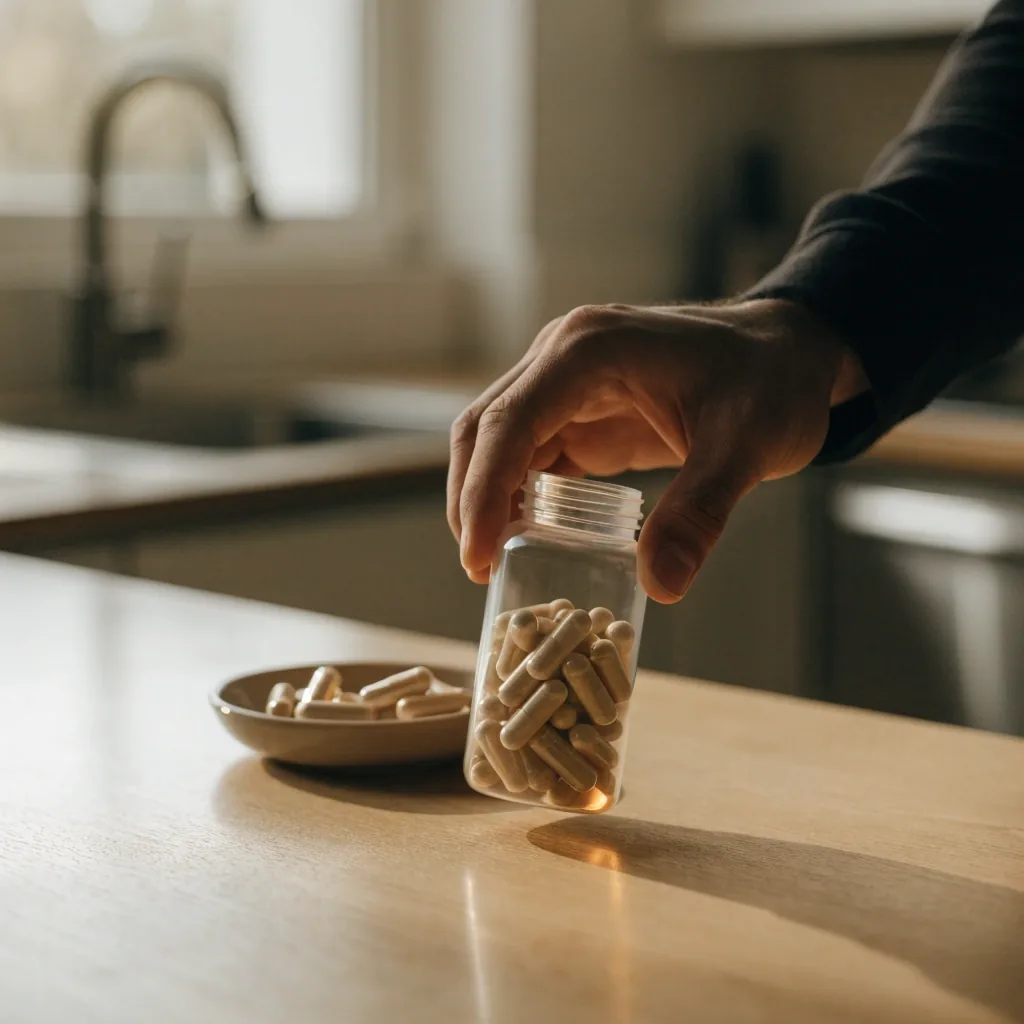
We set the guide first and the verdict second. If a panel will not let us read the numbers, our answer is a limitation, not a recommendation.
Editorial approach · Vital Oxygen Boost, Jakarta
Where to take the shortlist next
You have the eight checks and the arithmetic. The next pages do the work in order: read the comparisons, then a full review of the line you are leaning toward, then the glossary if a panel term stops you.
Nature Made Advanced Multivitamin Men
Read the full reviewGNC Mega Men Multivitamin
Read the full reviewHow we judge a formula
Our editorial approachStill unsure which tier fits your month?
Ask us a questionVital Oxygen Boost · Jl. Jenderal Sudirman No. 52, Jakarta 12190, Indonesia · Monday to Friday, 9:00 AM – 6:00 PM (WIB)